Talking Beasts’ reversion rule
The Last BattleThe Talking Beasts’ reversion rule is the warning that Narnian animals who fail to be good may lose their speech and return to ordinary animal life. First taught as a story of the world’s beginning and a conditional threat, it becomes an immediate terror when Ginger can no longer speak; at the final Door, the rule takes on a decisive spiritual and narrative form, as the creatures’ encounter with Aslan separates those who enter with him from those who disappear into his shadow.
The Warning and Its First Fulfillment
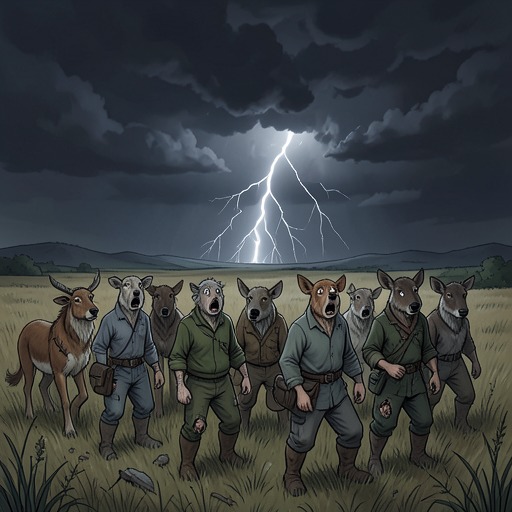
The Narnian animals had been taught from chickhood, puppyhood, or cubhood that Aslan had made the beasts of Narnia into Talking Beasts at the beginning of the world. They had also been warned that if they were not good, they might one day be turned back into the sort of witless, non-speaking animals found in other countries. The rule therefore joins speech to a moral condition: talking is not simply an animal trait, but a distinction that can be forfeited.
The threat becomes concrete when Ginger tries to answer the Captain. The Captain demands that the Cat stop making noise and talk, but Ginger produces only the ordinary sounds of an angry or frightened cat. The longer he caterwauls, the less he looks like a Talking Beast. The Boar recognizes what has happened: Ginger has forgotten how to talk and has become a dumb beast. The other Narnians understand the implication at once and fear that the same change is coming for them.
Their terror turns into a plea to Shift. They beg him to stand between them and Aslan, because they have been taught that he is the one who goes in and speaks to Aslan on their behalf. Ginger, meanwhile, retreats farther up into a tree and is never seen again. His disappearance leaves the frightened animals with no reassurance that the change can be reversed.
Judgment at the Door
At the final Door, the rule is enacted on a larger scale. Aslan calls, “Now it is time!” and the Door flies open. Creatures stream toward him, and each must look into his face. Some respond with fear and hatred; among the Talking Beasts, that expression lasts only a fraction of a second before they cease to be Talking Beasts. They swerve to Aslan’s left and vanish into his great shadow, with no account given of what becomes of them.
Other creatures look at Aslan and love him, even when they are frightened. They enter through the Door on his right. Among those welcomed are the companions whom Tirian and his friends had believed dead: Roonwit, Jewel, the good Boar and Bear, Farsight, the Dogs and Horses, and Poggin. The scene makes the reversion rule part of a final division: the loss of speech accompanies rejection of Aslan, while those who enter with him remain among the gathered company.
The judgment is not presented as a simple test of whether a creature belongs to one species or another. Eustace recognizes among those who enter a Dwarf who had helped shoot the Horses. The decisive distinction is the response to Aslan’s face, not a straightforward catalogue of past deeds. The episode gives the earlier warning its fullest force while showing that the final outcome is determined in the encounter itself.
From Threat to Cosmic Ending
The rule’s movement from childhood teaching to Ginger’s loss of speech and then to the creatures’ judgment at the Door gives it a place in the book’s larger ending. The Door opens after Aslan calls the time, and the stars have already been summoned home: the darkening sky is revealed as emptiness where the stars have been, while the stars themselves descend as people. The sorting of the creatures thus occurs as Narnia’s familiar order is giving way to its end.
After the creatures pass through, Aslan tells the Time-giant to make an end. The giant crushes the Sun in his hand, and darkness falls. Later, Aslan tells the children that a real railway accident has killed them and their parents, and that the dream is over and the morning has begun. The rule’s final setting is therefore not merely the restoration of an old Narnia: it belongs to a passage from a world reaching its end toward the beginning of what Aslan calls the Great Story.
Meaning and Limits
The warning initially gives the animals a stark account of their vulnerability: the speech that distinguishes them can be taken away. Ginger’s reversion makes that possibility audible and visible, as words give way to ordinary cat noises and the watching Beasts recognize the change. Their appeal to Shift also exposes how fear can turn a religious warning into dependence on a supposed intermediary.
At the Door, the rule becomes part of a final separation rather than a general explanation of animal life. Creatures who meet Aslan with fear and hatred lose their Talking-Beast status and disappear; those who love him enter, including a Dwarf associated with violence against the Horses. The narrative does not explain what happens to those who vanish, or set out a complete account of why each creature responds as it does. It does, however, make the loss of speech a visible sign of separation from Aslan, and entry through the Door the corresponding sign of welcome into the new order.